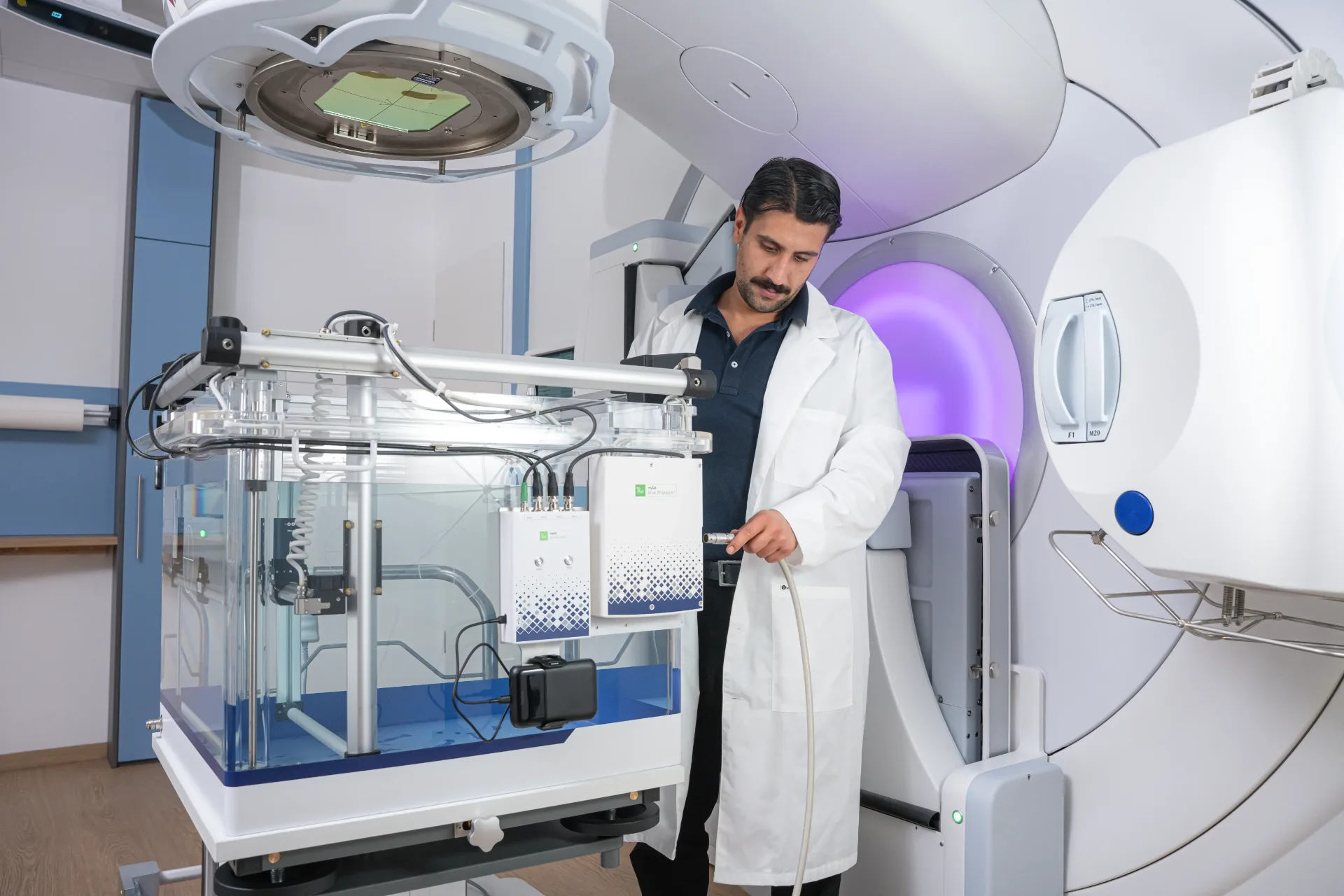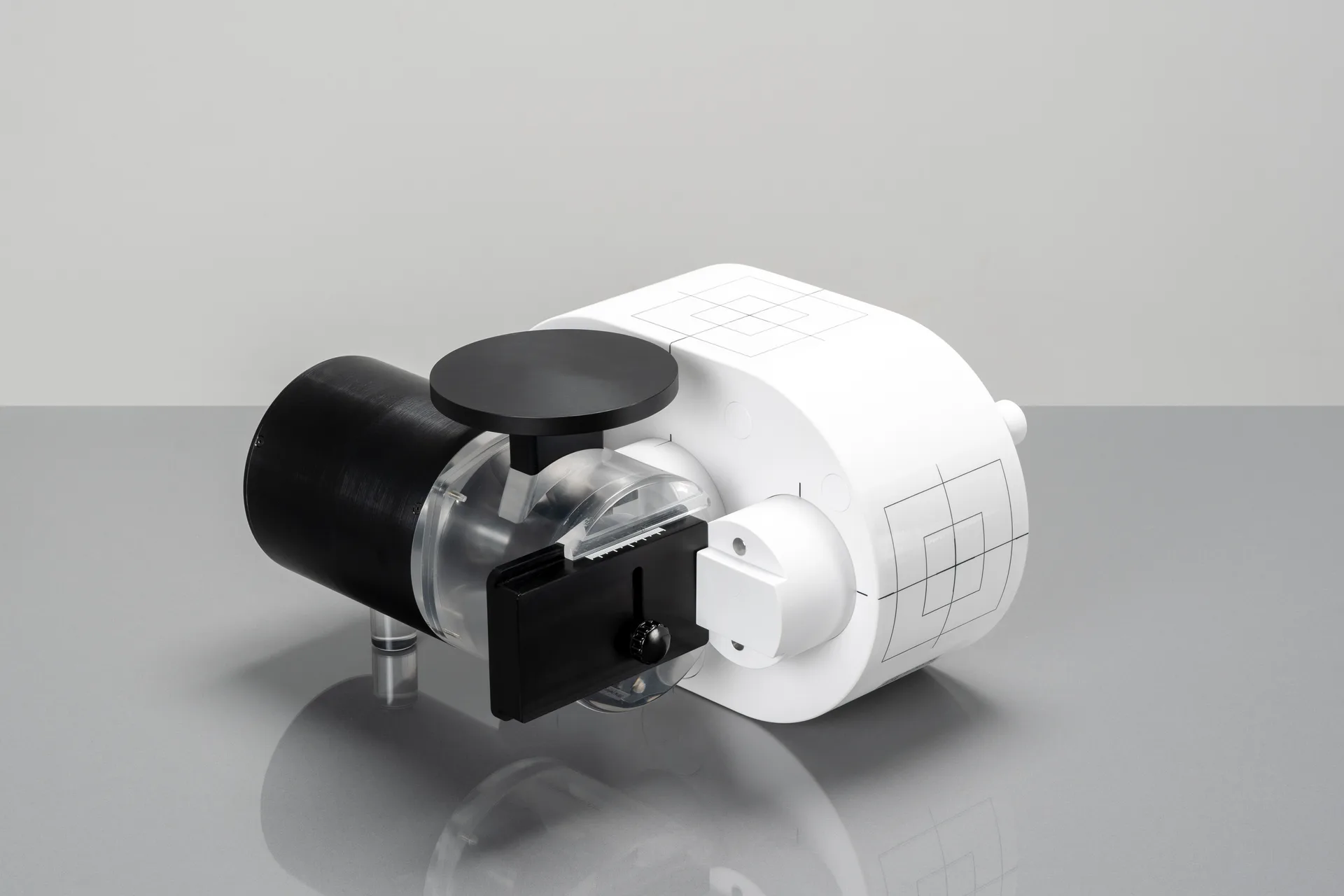
An intuitive tool offering comprehensive testing capabilities. Perform end‑to‑end motion management QA using intuitive software that precisely controls motion and enables the use of patient‑specific waveforms.
Compatible with: Adaptive, C-arm linacs, CBCT, CT Simulation, Bore-type linacs, Hypersight, IGRT, Motion Management, Small Field Dosimetry, SGRT, Helical linac, TG51, TG142, Machine Targeting
Used for: Imaging QA RT, Commissioning and Annual QA RT, Motion Management MQA
Truly Flexible, Modular Solution
Can be used either as a static, multi purpose body phantom V2.0 or paired with a respiratory motion assembly to suit diverse test scenarios.
Best for
✓ 4D CT and 4D imaging QA ✓ Gated treatment QA ✓ Motion management system validation ✓ Dose verification in moving Targets ✓ Linac latency testing for gating & tracking workflows
When Motion isn’t Managed, Confidence is Lost
The Challenge
One of the greatest challenges in radiotherapy is managing respiratory motion. Tumors in the thoracic and upper abdomen can shift several millimeters during the breathing cycle. If left uncompensated, this motion compromises targeting accuracy, increases dose to surrounding healthy tissue and ultimately threatens treatment outcomes. Even with advanced technologies such as IGRT and SGRT, without rigorous QA, motion variability introduces uncertainty into every treatment delivered. Without efficient, reliable motion QA, clinicians spend more time managing risk instead of treating patients.
The Solution
QUASAR Respiratory Motion Phantom 2.0 (pRESP) addresses these challenges directly. As a programmable breathing and tumor motion simulator it allows physicists to perform end-to-end QA on motion-guided RT systems under clinically realistic conditions.
The phantom features a body oval and accessories made from water and tissue equivalent materials, replacing acrylic, to more accurately replicate patient conditions. This upgrade delivers higher-fidelity QA results and reduces the gap between phantom testing and true clinical performance, empowering physicists to verify that their systems are not just functioning but performing at the standard required for modern motion-guided radiotherapy.
Quantify beam response timing
Verify the delay between beam-on/off commands and linac response using a validated workflow. By measuring latency independently of acquisition and algorithm delays, clinical teams can benchmark machine performance, support motion-managed treatments, and detect performance drift over time.
Benefits:
- Validate beam-on and beam-off timing for gating workflows
- Support SRS and SBRT treatments requiring tight margins
- Benchmark linac performance across systems
- Detect latency changes before they impact clinical treatments
- Eliminate complex oscilloscope-based measurement setups
When timing isn't verified, accuracy is at risk
In motion-managed treatments such as gating, tracking, and breath-hold techniques, treatment accuracy depends not only on motion detection but also on how quickly the linac responds. Delays between beam-on/off commands and radiation delivery can affect target coverage and increase dose to healthy tissue, particularly in SRS and SBRT treatments where margins are extremely small.
The QUASAR pRESP 2.0 Latency Test enables standardized verification of linac response timing using validated pulse signals. By separating linac latency from acquisition and algorithm delays, clinics can accurately benchmark machine performance, monitor changes over time, and support compliance with recommended QA procedures
Integrate your motion QA with the leaders in SGRT
QUASAR pRESP 2.0 is engineered for precision and clinical versatility. It aligns seamlessly with leading SGRT systems and supports motion tracking and gating via a dedicated chest wall surrogate. It offers:
- Optimized chest wall–to–linear motion ratio.
- 6+ ion chamber locations.
- Interchangeable solid water and lung-equivalent inserts.
This combination delivers a comprehensive QA platform for advanced motion management and treatment simulation.
The phantom is fully compatible with SGRT systems including Vision RT, C-RAD, Brainlab®, and Varian® Identify. Patient-specific waveforms can be imported from a wide range of motion capture and waveform generation tools, supporting formats such as VXP, CSV, TXT, DCM, LOG, DAF, and IMA.
Features
End-to-End Dosimetric Confidence
Ensure accuracy in motion-affected treatments with our new water-equivalent phantom. Featuring 6+ ion chamber positions and customizable drillable inserts, it empowers clinicians to precisely measure and verify delivered dose. Resulting in greater confidence in system performance and trust that patients are receiving the treatment exactly as intended.
Simplicity
An easy-to-use phantom with comprehensive testing capabilities for demanding motion protocols in modern radiation therapy departments. From its manual operation mode to its magnetic insert connection, QUASAR pRESP 2.0 is designed with the end user in mind, providing an intuitive motion-management QA tool.
Motion Control Options
Users can select between local manual control at the motor or advanced, software-driven programmability. The phantom supports simple translational motion or complex 3D trajectories when paired with the QUASAR [DH1] Respiratory Motion Rotation Stage (ITEM# 500-3330). Patient-specific waveform testing elevates QA by pushing the limits of motion management systems under realistic conditions.
Motion Precision
Accurate tumor targeting in motion-affected treatments depends on precise respiratory motion replication. QUASAR pRESP 2.0 exhibits detailed sensitivity when replicating captured or created waveforms. A highly responsive motor repositions the translation stage every 10 ms (100x per second) providing real-life breathing replication. Waveforms from 0 to 60 BPM are replicated with ease, testing a large range of clinical protocols. The phantom meets AAPM TG-76 and TG-324 recommendations, ensuring reproducibility and reliability across evolving radiotherapy techniques.
Versatility
QUASAR pRESP 2.0 supports a wide library of interchangeable inserts including water-equivalent, tissue-equivalent, and acrylic options, enabling validation across CT, linac, and PET workflows. Inserts accommodate ion chambers, film cassettes, and OSLD holders for end-to-end dosimetry and Imaging QA. pRESP provides users with the flexibility to operate it as a static phantom or integrate it with the responsive motor and software for motion-guided applications.
Software and Workflow Efficiency
Included with the phantom is the QUASAR Respiratory Motion QA Software that provides intuitive, programmable motion control. Users can create, customize, and import motion profiles, including patient-specific waveforms. It also incorporates a Deep Inspiration Breath Hold (DIBH) testing mode, improving workflow efficiency for clinical teams validating advanced treatment techniques.
Complex Motion Control Options
With software-driven motion profiling, users can eliminate uncertainty in QA. From simple periodic motions for quick checks to complex 3D waveform playback for advanced validation, the system adapts to the complexity of clinical needs. This flexibility ensures confidence in system accuracy and patient safety.
Customizable Waveforms
Beyond its extensive pre-loaded waveform library, the software accepts imported data from major respiratory gating and tracking systems. Fully customizable editing tools allow physicists to refine waveform characteristics for protocol-specific testing, ensuring precise replication of clinical scenarios.
Accessories and Technical Specifications
Technical specifications
- Body Oval: 30 cm wide, 20 cm high, 12 cm long, RW3, 4.3 kg.
- Drive unit :30 cm long, 30 cm wide, 12 cm high, 4 kg, RW3 in field of view.
- Respiratory Phantom mass: approximately 11 kg with Body Oval and all options.
- Three openings in Body Oval for static insert, drive unit and moving Insert, 8 cm diameter.
- Chest Wall Platform; 13 cm diameter, carries up to 1 kg.
- Power Supply; Input, 100–240VAC, 47–63 Hz, International power cords available on request. Output, 24VDC, 2.1 A, 50 W. Approvals; CE, cUL
- User's guide.
Optional Accessories
- Beam Signal Processor (BSP)
- RESP-Rotation Stage
- Electron Density Ring water equivalent
- MP/pRESP-Two Piece holder for MOSFET
Minimum Technical Requirements
- Operating System: Windows 10 or 11.
- Ports: 1 Ethernet.
QUASAR™ Respiratory Motion Phantom
- 1-Phantom
- 1-Software License
Optional Inserts
- Additional RW3 Ion Chamber Holder- MP, RESP (major suppliers available on request)
- Dummy Polystyrene Ion Chamber- (NE2571 0.60cc Farmer Type)
- Cedar Insert with Solid Tumor centered
- Cedar Insert with Solid Tumor (15 mm) centered
- Cedar Insert with Solid Tumor (30mm) plus Gold Fiducials -centered
- Cedar Insert with Solid Tumor centered- drilled for Ion Chamber
- Cedar Insert with Solid Tumor (15 mm) centered-drilled for IC
- Cedar Insert with Solid Tumor (30mm) with Gold Fiducials centered - Drilled for IC
- Cedar Insert with Split Tumor centered- for Gafchromic film
- Cedar Insert - Split - Centered 32 mm Cube Opening
- Hollow Insert with screw cap (7.25cm inside diameter)
- 4D CT Imaging Insert
- PET CT Insert
- RW3 MP Insert Adapter
- Offset-Cedar Insert with Solid Tumor
- Offset Cedar Insert with Solid Tumor (15mm)
- Offset Cedar Insert with Solid Tumor (30 mm) plus Gold Fiducials – for imaging
- Offset-Cedar Insert with Solid Tumor- drilled
- Offset Cedar Insert with Solid Tumor (15 mm) -drilled for IC
- Offset Cedar Insert with Solid Tumour (30 mm) plus Gold Fiducials –drilled for IC
- Offset-Cedar Insert with Split Tumor- for Gafchromic film
- Offset-Cedar Insert with Split Tumor - Multiple OSLD Holder
- Offset-Cedar Insert - drilled for Ion Chamber
- Offset-Cedar Insert - Split - Offset 32 mm Cube Opening
- Solid sphere with Gold Fiducials
- Split Sphere with Gold Fiducials
- RESP - Split Cedar Dual Target Insert - 30mm tumor in the offset position with adjacent 15mm tumour shifted 45degree towards the center
- RESP - Cedar Insert - drilled for Ion Chamber (Centered)
- MP-Spatial Resolution Insert (CT Imaging)
- MP- Bone Rod with 5mm Titanium Rod Insert
- MP-Cedar Ion Chamber Holder Insert (drilled)
- Arcylic ion Chamber Holder
- 125/27cc dual cube insert (acrylic)
- 60 degree air wedge insert (acrylic)
- 20 degree air wedge, 5mm rod and 10mm rod insert (acrylic)
- RW3 insert with offset tumour (30mm) drillable for ion chamber
- Split RW3 Insert with 30mm and 15mm tumor targets